



The IELTS General Writing Task 2 is essential to the International English Language Testing System (IELTS) examination. It is designed to assess a candidate's ability to express opinions, analyze arguments, and provide solutions to relevant issues in a coherent and structured manner. This task holds significant weightage in evaluating an individual's English proficiency.
This comprehensive guide will delve into the intricacies of IELTS General Writing Task 2, offering valuable insights, tips, and strategies to help you excel in this section.
Understanding IELTS General Writing Task 2
The IELTS General Writing Task 2 requires candidates to write an essay responding to a prompt or question. This task evaluates the candidate's ability to present a well-organized argument or viewpoint on a given topic. The essay should be written formally and demonstrate the candidate's command over the English language, including vocabulary, grammar, and coherence.
Top 10 Tips For IELTS Preparation
Structure of the Task
Introduction: The essay should begin with an introduction that briefly overviews the topic and presents the central argument or viewpoint.
Body Paragraphs: The body paragraphs should elaborate on the central argument or viewpoint presented in the introduction. Each paragraph should focus on a specific aspect or idea related to the topic and should be supported by relevant examples, evidence, or explanations.
Conclusion: The essay should conclude with a summary of the main points discussed in the body paragraphs and a restatement of the thesis or central argument.
|
 Talk to an Expert
Tips for Success in IELTS General Writing Task 2
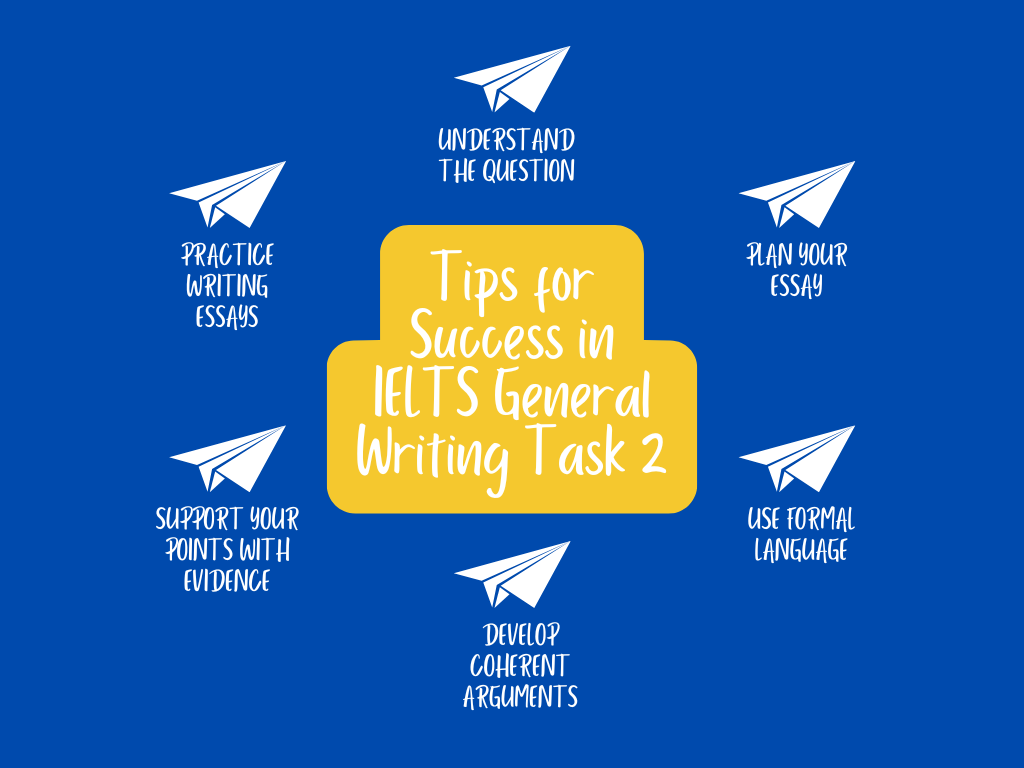
- Understand the Question: Before writing, ensure you fully understand the question or prompt. Identify the keywords and concepts and consider how you will approach the topic.
- Plan Your Essay: Take some time to brainstorm ideas and plan your essay structure. Consider the main points you want to cover in each paragraph and the overall argument or viewpoint you wish to convey.
- Use Formal Language: The essay should be written in a formal style appropriate for academic or professional settings. Avoid using slang, colloquial language, or contractions.
- Develop Coherent Arguments: Ensure your essay has a clear and logical structure. Each paragraph should focus on a single main idea, and there should be a smooth transition between paragraphs.
- Support Your Points with Evidence: Use examples, statistics, or personal experiences to support your arguments. This will add credibility to your essay and demonstrate your critical thinking ability.
- Manage Your Time Wisely: The IELTS General Writing Task 2 has a time limit of 40 minutes. Allocate your time wisely, and leave enough time to proofread and edit your essay.
- Practice Writing Essays: Practice is critical to improving your writing skills. Take time to write practice essays on various topics and ask for feedback from teachers or peers.
Common Pitfalls to Avoid
- Lack of Focus: Ensure your essay stays focused on the topic and avoids drifting off into unrelated tangents.
- Poor Grammar and Vocabulary: Attention to grammar, punctuation, and vocabulary usage. Avoid common errors and strive for clarity and precision in your writing.
- Plagiarism: Do not copy directly from the question or other sources. Use your own words and ideas to express your thoughts and arguments.
- Overly Complex Language: While it's important to demonstrate a wide range of vocabulary, use a simple language that may be clear to the reader. Aim for clarity and simplicity in your writing.
Best IELTS Preparation Classes in Nepal
IELTS General Writing Task 2: Essay Sample Answers
Some people say that the Government should break down all the historic buildings and replace them with modern buildings. Do you agree or disagree?
Undeniably, every nation's monuments and historic buildings represent its heritage. However, some individuals advocate for demolishing these structures in favor of modern buildings. These historic landmarks are invaluable assets that deserve reverence and preservation.
Firstly, historic sites embody the cultural history of a nation, serving as tangible reminders of past civilizations and their contributions. They play a crucial role in educating future generations about their ancestors' struggles and achievements. Additionally, visiting these sites fosters a deeper understanding of history and encourages reflection on lessons learned from the past.
Moreover, historic landmarks contribute significantly to a country's economy by attracting tourists and generating revenue. Tourist spending supports local businesses and fuels the growth of industries such as handicrafts. Furthermore, tourism promotes cultural exchange and fosters goodwill among nations, enhancing global connections and understanding.
In conclusion, preserving historic sites is vital for safeguarding a nation's history and identity. The benefits extend beyond economic gains, encompassing cultural enrichment and intercultural dialogue. Therefore, we must cherish and protect these irreplaceable treasures for future generations to appreciate and learn from.
When a country develops its technology, the traditional skills and ways of life die out. It is pointless to try and keep them alive. Do you agree or disagree with this statement?
As technology advances rapidly, traditional skills and ways of life are inevitably fading away. In this digital age, preserving traditional values is becoming increasingly futile.
Firstly, the advent of mobile phones has revolutionized communication, rendering traditional methods obsolete. In the past, people relied on letters and endured long queues at telephone booths for a single call. However, modern technology has made communication instantaneous and effortless. Secondly, advancements in technology have transformed various industries, including fashion. Manual tasks such as knitting and stitching have been replaced by machines, making production faster and more efficient. For instance, fashion students now utilize advanced software for color compatibility checks instead of manually comparing swatches. Additionally, innovations like refrigerators have diminished the need for traditional practices like using pitchers for cooling water.
In conclusion, traditional methods cannot keep pace with modern trends as technology evolves. Therefore, preserving them is futile and impractical in the face of technological progress.


