



The IELTS, short for the International English Language Testing System, is a widely recognized examination taken by millions worldwide, particularly by individuals seeking opportunities for higher education or employment abroad. Attaining a commendable score in the IELTS exam is paramount for realizing your aspirations and enhancing your prospects of success.
Nonetheless, preparing for this exam can feel overwhelming, particularly for those unfamiliar with its structure and requirements. In this blog post, we aim to furnish you with ten actionable tips that can significantly enhance your chances of securing a high score on the IELTS exam, thus facilitating the achievement of your desired outcomes.
Whether you're embarking on your maiden attempt or a seasoned test-taker seeking improvement, these tips will serve as invaluable guidance throughout your preparation journey, equipping you with the necessary skills to thrive in the IELTS exam.
To excel in the IELTS exam, you must understand its format, content, and strategies for tackling each section effectively. In this comprehensive guide, we'll discuss expert tips and techniques for achieving a high score in the IELTS exam.
Top 10 Tips For IELTS Preparation
Understanding the IELTS Exam
The test comprises four sections: Listening, Reading, Writing, and Speaking. Each section assesses different language skills and has specific formats and instructions.
- Listening: This section consists of four recorded monologues and conversations. Test-takers listen to the recordings and answer a series of questions. Tips for this section include active listening, predicting answers, and practicing with various accents.
- Reading: The Reading section includes three long passages with various question types, such as multiple choice, matching headings, and True/False/Not Given. Effective reading strategies include skimming, scanning, and understanding question types.
- Writing: In the Writing section, candidates must complete two tasks: Task 1 (Report Writing for Academic, Letter Writing for General Training) and Task 2 (Essay Writing). Key tips for this section include planning your response, organizing ideas coherently, and demonstrating a wide range of vocabulary and grammar structures.
- Speaking: The Speaking section involves a face-to-face interview with an examiner. It assesses the candidate's ability to communicate fluently and coherently on various topics. Strategies for this section include practicing speaking regularly, expanding vocabulary, and maintaining confidence.
|
 Talk to an Expert
Tips to Achieve a High Score in the IELTS Exam
Understand the Scoring Criteria:
Familiarize yourself with the IELTS scoring criteria for each section. This will help you understand what examiners are looking for and how to meet their expectations.
Practice Regularly:
Consistent practice is key to success in the IELTS exam. Set aside time each day to practice different sections of the test, focusing on areas for improvement.
Develop Time Management Skills:
Time management is crucial, especially in the Reading and Writing sections, where you have limited time to complete tasks. Practice timed exercises to improve your speed and efficiency.
Expand Your Vocabulary:
Work on expanding your vocabulary by learning new words and phrases regularly. Use vocabulary lists, flashcards, and context-based learning methods to enhance your word bank.
Improve Grammar and Sentence Structure:
Pay attention to grammar rules and sentence structures. Practice writing grammatically correct sentences and varied sentence structures to demonstrate language proficiency.
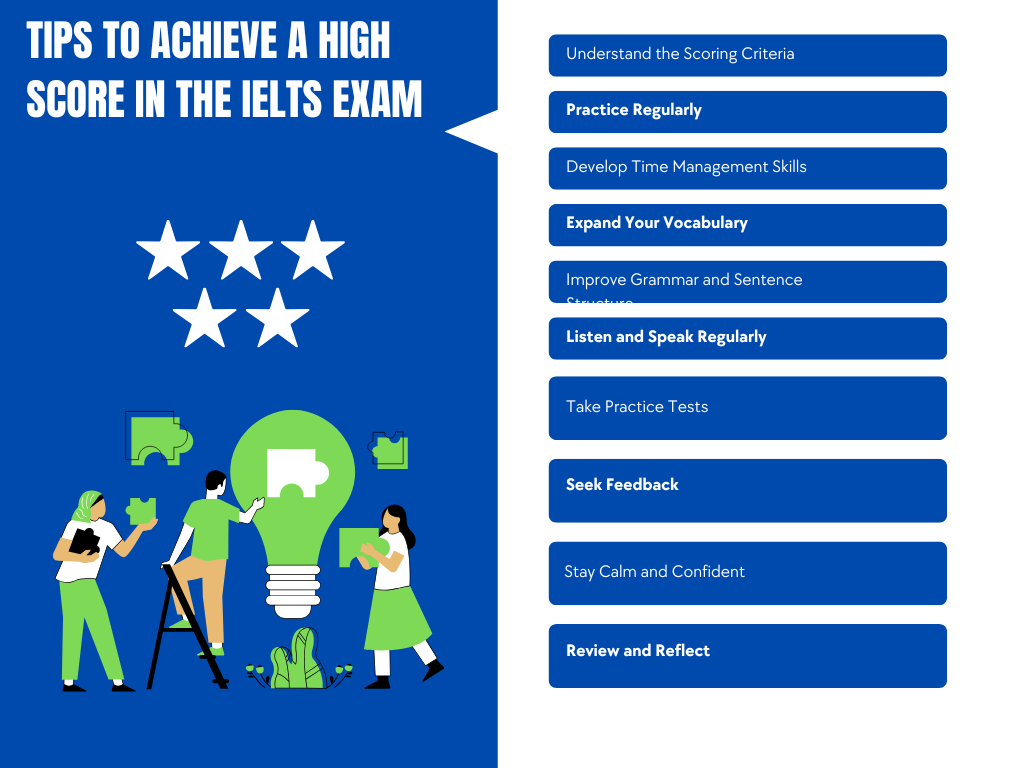
Listen and Speak Regularly:
Engage in regular listening and speaking practice to improve your listening comprehension and speaking skills. Listen to podcasts, watch English movies or TV shows, and participate in speaking activities with friends or language partners.
Take Practice Tests:
Take full-length practice tests under exam conditions to simulate the real test environment. Analyze your performance, identify weaknesses, and work on improving them.
Seek Feedback:
Get feedback from teachers, tutors, or language experts to identify areas for improvement. Constructive feedback can help you refine your skills and overcome weaknesses.
Stay Calm and Confident:
On the day of the exam, stay calm and confident. Manage test anxiety by practicing relaxation techniques such as deep breathing or visualization.
Review and Reflect:
After taking practice tests or the actual exam, review your performance. Identify mistakes and areas for improvement, and adjust your study plan accordingly.


