



The International English Language Testing System (IELTS) is a cornerstone for individuals aiming to study or work in English-speaking countries. Whether you're seeking admission to a university, applying for a job, or aiming for immigration purposes, taking the IELTS exam is paramount. However, mastering the IELTS requires more than language proficiency; it demands strategic preparation and a well-structured study plan tailored to individual needs.
As we enter 2026, let's delve into a comprehensive IELTS preparation strategy and study plan to guide aspirants towards success.
How to Prepare For IELTS
Understanding the IELTS Exam:
Before diving into preparation strategies, it's crucial to grasp the format and components of the IELTS exam. The IELTS exam comprises four sections: Listening, Reading, Writing, and Speaking. Each section assesses different language skills, including comprehension, vocabulary, grammar, and fluency. Understanding the nuances of each section is essential for formulating an effective study plan.
- Listening: This section consists of four recorded monologues and conversations. Test-takers listen to each recording once and answer questions based on the content. Key strategies include practicing active listening, note-taking, and familiarizing oneself with various English accents.
- Reading: The Reading section evaluates comprehension skills through three passages of increasing complexity. Candidates must answer various questions, including multiple-choice, matching, and true/false/not given. Effective strategies involve skimming, scanning, and time management.
- Writing: In the Writing section, candidates must complete tasks 1 (describing visual information) and 2 (writing an essay). Time management, coherence, and vocabulary selection are pivotal for achieving high scores in this section.
- Speaking: The Speaking section assesses oral proficiency through a face-to-face interview with an examiner. Test-takers engage in a structured conversation covering various topics, including personal experiences, opinions, and abstract ideas. Confidence, fluency, and coherence play a vital role in this section.
|
 Talk to an Expert
Formulating an IELTS Preparation Strategy
Now that we've familiarized ourselves with the exam structure let's outline a comprehensive preparation strategy tailored to maximize performance in each section.
Assess Your Current Level:
Take a diagnostic IELTS practice test to gauge your proficiency level in each section. This assessment will help identify strengths and weaknesses, enabling you to focus on areas that require improvement.
Set Realistic Goals:
Establish clear and achievable goals based on your target IELTS score and timeline. Break down your goals into smaller milestones, allowing steady progress throughout your preparation journey.
Develop a Study Schedule:
Design a structured study schedule that allocates sufficient time for each exam section. Incorporate regular practice sessions, review periods, and simulated test simulations to build stamina and familiarity with the exam format.
Utilize Reliable Resources:
Invest in high-quality study materials, including official IELTS practice tests, preparation books, and online resources. Leverage reputable websites, mobile apps, and educational platforms offering interactive exercises and sample questions.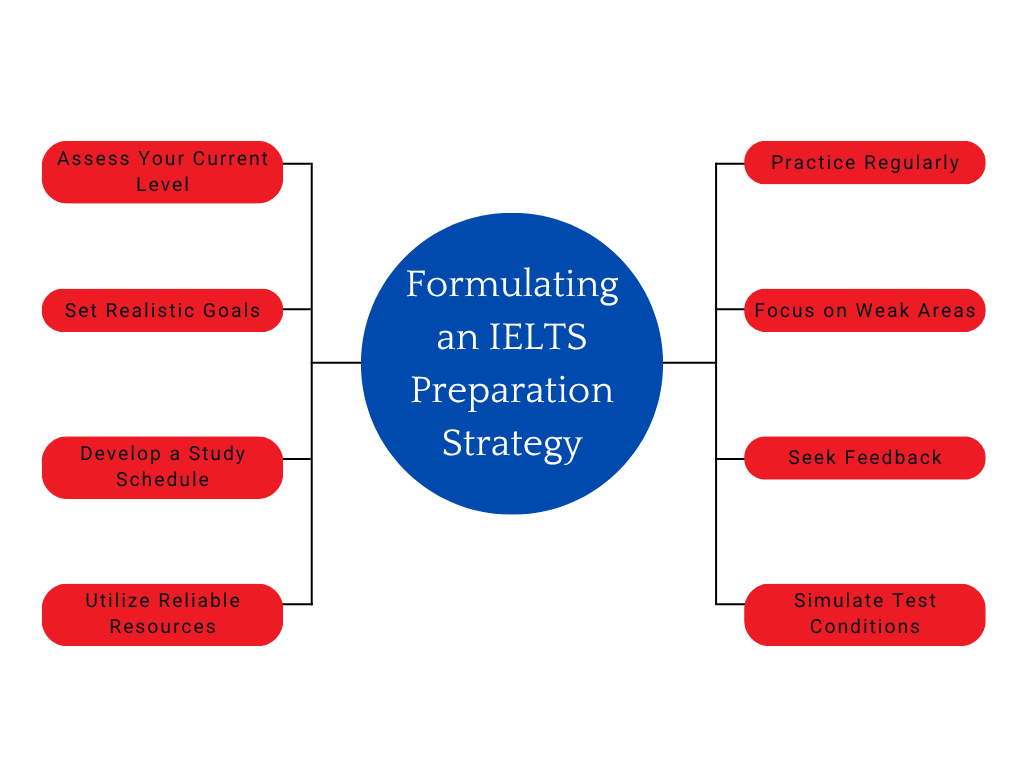
Practice Regularly:
Consistent training is key to success in the IELTS exam. Dedicate ample time to daily practice sessions focused on listening, reading, writing, and speaking skills. Incorporate various practice materials to expose yourself to diverse topics and question formats.
Focus on Weak Areas:
Identify your weakest areas based on practice test performance and allocate additional time and resources to strengthen these skills. Whether improving vocabulary, enhancing grammatical accuracy, or refining pronunciation, targeted practice is essential for progress.
Seek Feedback:
Solicit feedback from peers, teachers, or online forums to evaluate your performance and identify areas for improvement. Engage in mock speaking sessions, writing workshops, and peer reviews to receive constructive criticism and refine your skills.
Simulate Test Conditions:
As your exam date approaches, simulate actual test conditions by completing full-length practice tests under timed conditions. This will help build endurance, improve time management, and reduce test anxiety on exam day.
Top 10 Tips For IELTS Preparation
Creating a Personalized Study Plan
Now that we've outlined the overarching preparation strategy let's delve into a detailed study plan tailored to individual preferences and requirements.
Week 1-2: Diagnostic Assessment and Goal Setting
- Take a full-length diagnostic IELTS practice test to assess your current proficiency level.
- Analyze your test results to identify strengths and weaknesses in each section.
- Set realistic goals based on your target IELTS score and timeline for preparation.
Week 3-4: Familiarization and Resource Acquisition
- Familiarize yourself with the format and structure of the IELTS exam by reviewing official exam guidelines and sample questions.
- Invest in reliable study materials, including IELTS preparation books, online courses, and practice tests.
- Create a designated study space free from distractions to facilitate focused learning.
Week 5-8: Section-Specific Practice
- Allocate specific time slots for practicing each section of the IELTS exam (Listening, Reading, Writing, Speaking).
- Utilize various practice materials, including audio recordings, reading passages, writing prompts, and speaking topics.
- Focus on developing essential skills such as active listening, reading comprehension, essay writing, and oral fluency.
Week 9-12: Targeted Skill Enhancement
- Identify your weakest areas based on practice test performance and prioritize targeted skill enhancement.
- Dedicate extra time and resources to improving vocabulary, grammar, pronunciation, and coherence in writing and speaking.
- Engage in focused practice exercises and seek peer, teacher, or online tutor feedback to track progress.
Week 13-16: Mock Test Simulations and Review
- Schedule regular mock test simulations under timed conditions to simulate real exam conditions.
- Analyze your performance in each section and identify areas for further improvement.
- Review incorrect answers, analyze mistakes, and understand the rationale behind correct responses.
Week 17-20: Refinement and Final Review
- Refine your exam strategies based on feedback and lessons learned from mock test simulations.
- Focus on building confidence, improving fluency, and fine-tuning your exam techniques.
- Engage in final review sessions to consolidate knowledge, reinforce key concepts, and address doubts or uncertainties.
Week 21-24: Exam Preparation and Relaxation
- Finalize your exam preparation by completing a few more full-length practice tests and fine-tuning your test-taking strategies.
- Prioritize self-care and relaxation in the days leading up to the exam to ensure optimal mental and physical well-being.
- Approach the exam day confidently, knowing you've invested time and effort in thorough preparation.


