



The IBSAT (ICFAI Business School Aptitude Test) is a critical stepping stone for aspiring management professionals seeking admission to the prestigious MBA/PGPM programs offered by the ICFAI Business School (IBS).
IBSAT is a computer-based test (CBT) conducted annually by the ICFAI Foundation for Higher Education. It evaluates a candidate's aptitude in various areas essential for management education. The test comprises multiple-choice questions (MCQs) across four sections: Verbal Ability, Reading Comprehension, Quantitative Aptitude, and Data Interpretation & Sufficiency.
This article aims to provide a detailed insight into the IBSAT paper pattern and syllabus, equipping candidates with essential knowledge to ace the examination.
Also Read: IBS Aptitude Test (IBSAT)
IBSAT Exam Pattern and Syllabus: Key Insights
- The IBSAT exam pattern and syllabus encompass 140 question topics divided into 4 sections.
- Notably, Verbal Ability and Reading Comprehension are presented as distinct sections in the IBSAT 2023 syllabus.
- In the IBSAT Exam Pattern and Syllabus, the Verbal Ability (VA) section holds the highest weightage, accounting for 36%, with 50 MCQs in the IBSAT 2023 syllabus.
- Other sections in the IBSAT exam 2023 Syllabus carry a weightage of 21.4%, with 30 MCQs in each section.
- The IBSAT syllabus and pattern comprehensively cover all crucial topics across the 4 sections of the exam.
- The syllabus topics in IBSAT are aligned with those of other top MBA entrance exams such as CAT, XAT, CMAT, NMAT, and MAT.
- The difficulty level of questions in the IBSAT syllabus and pattern ranges from easy to moderate.
- Notably, the IBSAT syllabus and pattern follow a no negative marking pattern for wrong answers in the exam.
|
 Talk to an Expert
IBSAT Paper Pattern
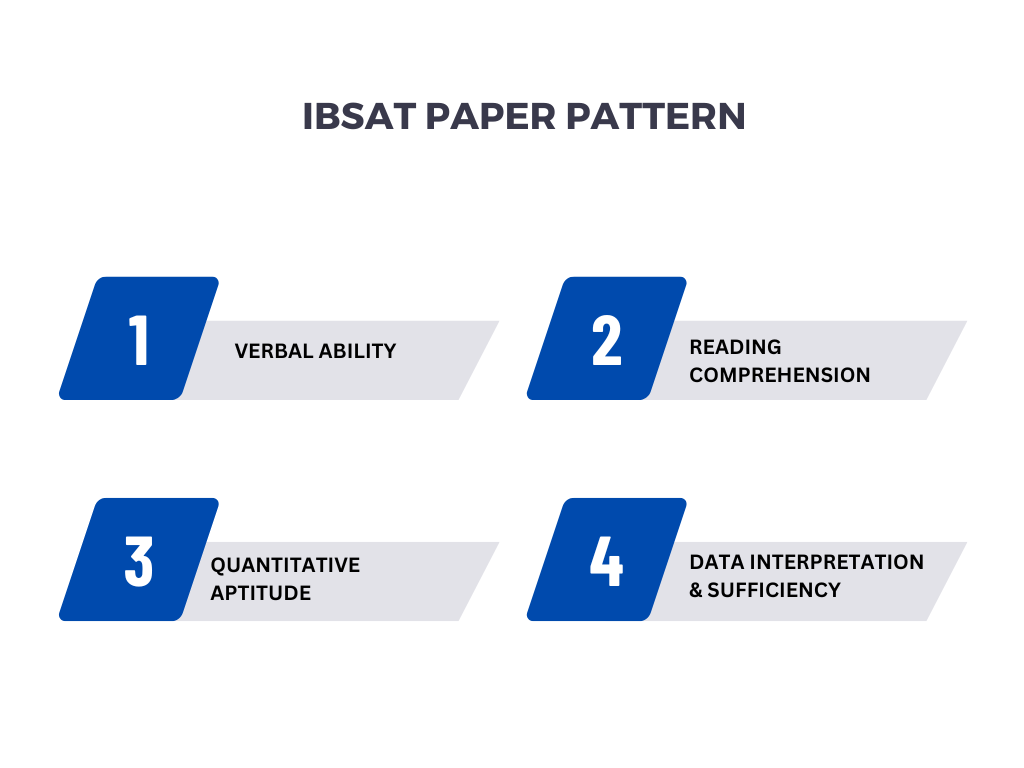
- Verbal Ability: This section assesses a candidate's proficiency in English language skills, including grammar, vocabulary, and verbal reasoning. Questions may include sentence correction, fill-in-the-blanks, and analogies.
- Reading Comprehension: Candidates are tested on their ability to comprehend and analyze passages of varying lengths and complexity. Questions may range from identifying main ideas and supporting details to drawing inferences and conclusions.
- Quantitative Aptitude: This section evaluates mathematical aptitude and problem-solving skills. Topics covered include arithmetic, algebra, geometry, and data interpretation. Questions may involve calculations, equations, and logical reasoning.
- Data Interpretation & Sufficiency: Candidates are presented with data in various formats such as tables, graphs, and charts. They are required to interpret the data accurately and answer questions based on it. Additionally, questions on data sufficiency test analytical and logical reasoning abilities.
IBSAT Preparation :Strategy & Guide
Syllabus for IBSAT
Verbal Ability:
- Grammar: Parts of speech, tenses, subject-verb agreement, etc.
- Vocabulary: Synonyms, antonyms, analogies, idioms, etc.
- Verbal Reasoning: Sentence correction, fill in the blanks, para-jumbles, etc.
Reading Comprehension:
- Passage Analysis: Main idea, supporting details, tone, author's perspective, etc.
- Inference & Interpretation: Drawing conclusions, making inferences, identifying implicit information, etc.
Quantitative Aptitude:
- Arithmetic: Number system, percentages, profit & loss, ratio & proportion, etc.
- Algebra: Linear equations, quadratic equations, inequalities, etc.
- Geometry: Basic geometry, mensuration, trigonometry, etc.
- Data Interpretation: Tabular data, bar graphs, line graphs, pie charts, etc.
Data Interpretation & Sufficiency:
- Data Analysis: Interpretation of data presented in various formats.
- Data Sufficiency: Analyzing whether given data is sufficient to answer a question.
Tips for Preparation
- Understand the Exam Pattern: Familiarize yourself with the IBSAT paper pattern and syllabus to devise a strategic preparation plan.
- Strengthen Basics: Focus on building a strong foundation in fundamental English, mathematics, and data interpretation concepts.
- Practice Regularly: Solve various sample papers, mock tests, and previous years' question papers to improve speed and accuracy.
- Time Management: Practice time-bound solving to enhance efficiency during the examination.
- Seek Guidance: Consider joining coaching institutes or online courses for expert guidance and personalized preparation strategies.


