



Preparing for the Civil Services Examination, especially the prestigious Indian Administrative Service (IAS), demands a comprehensive approach, and staying updated with current affairs is indispensable. With the ever-evolving nature of the examination pattern and the increasing relevance of current events in governance, mastering current affairs has become crucial for aspirants aiming to crack the IAS exam in 2023.
In this article, we will delve into practical strategies and resources to navigate through the vast ocean of current affairs and emerge triumphant in the examination.
IAS Prelims 2023 Exam: Last-Minute Tips
The Significance of Current Affairs in IAS Preparation
The Civil Services Examination conducted by the Union Public Service Commission (UPSC) comprises multiple stages, including the Preliminary Examination, Main Examination, and the Interview. Current affairs play a pivotal role in each stage, influencing question patterns and candidates' overall performance.
In the Preliminary Examination, the General Studies Paper I extensively covers current affairs topics ranging from national and international events to government schemes and policies. Similarly, the Main Examination's General Studies Papers II, III, and IV evaluate candidates' understanding of contemporary issues and their analytical abilities in tackling them. Moreover, knowledge of current affairs is indispensable for the interview round, where candidates are expected to exhibit a nuanced understanding of socio-political, economic, and environmental developments.
|
 Talk to an Expert
Effective Strategies for Current Affairs Preparation
Develop a Structured Study Plan:
- Allocate dedicated time slots in your study schedule for current affairs.
- Prioritize topics based on their relevance and weightage in the examination.
- Divide your study plan into daily, weekly, and monthly segments to ensure comprehensive coverage.
Comprehensive Reading:
- Follow reputed newspapers such as The Hindu, The Indian Express, and magazines like Yojana, Kurukshetra, and Frontline for in-depth coverage of current events.
- Utilize online platforms like Press Information Bureau (PIB) and Rajya Sabha TV for reliable news updates and government initiatives.
- Subscribe to curated current affairs websites and newsletters for concise summaries and analysis.
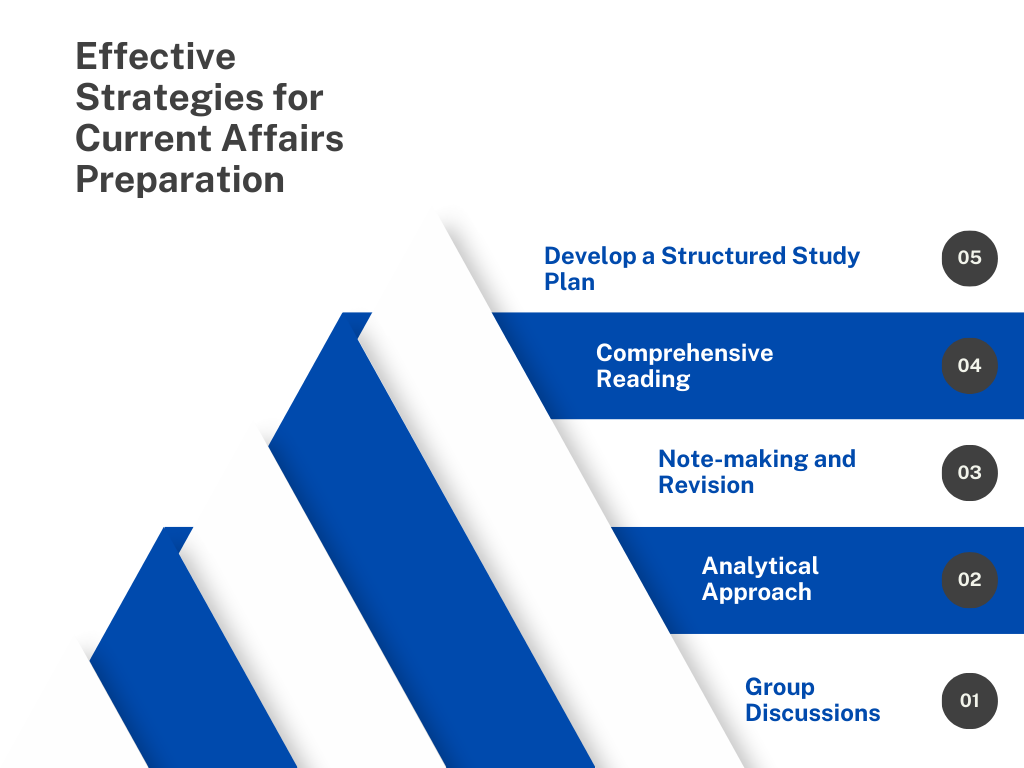
Note-making and Revision:
- Maintain a separate notebook or digital document for jotting down important news items, editorials, and opinion pieces.
- Use mind maps, charts, and diagrams to organize information and facilitate quick revision.
- Regularly revisit your notes and revise the key concepts to reinforce learning.
Analytical Approach:
- Develop critical thinking skills by analyzing major current affairs events' causes, consequences, and implications.
- Connect current events with static syllabus portions such as history, geography, economics, and polity for a holistic understanding.
- Practice answering mock questions and previous years' papers to enhance your problem-solving abilities.
Group Discussions and Peer Learning:
- Engage in group discussions with fellow aspirants to exchange perspectives and insights on current affairs.
- Participate in online forums and social media groups dedicated to IAS preparation for collaborative learning and idea-sharing.
- Form study circles or join coaching institutes offering specialized current affairs sessions for interactive learning.
How to Prepare for UPSC
Resources for Current Affairs Preparation
Newspapers:
- The Hindu
- The Indian Express
- Business Standard
Magazines:
- Yojana
- Kurukshetra
- Frontline
Government Portals:
- Press Information Bureau (PIB)
- Rajya Sabha TV
- Ministry of External Affairs (MEA) website
Online Platforms:
- Insights On India
- ClearIAS
- Civilsdaily
Mobile Applications:
- Daily Current Affairs and GK
- Civil Services Companion
- GKToday


