



In a world increasingly driven by technology and STEM (Science, Technology, Engineering, and Mathematics) fields, the value of humanities education often gets overlooked. However, contrary to popular belief, humanities subjects such as literature, history, philosophy, and art can open up numerous job opportunities for students.
The testimonies of successful humanities graduates provide compelling evidence of the value of humanities education in today's job market. Far from being obsolete, humanities disciplines offer a pathway to diverse and fulfilling careers where critical thinking, creativity, and empathy are prized qualities.
By recognizing the multifaceted skills acquired through humanities study, students can confidently pursue their passions and unlock opportunities in an increasingly complex and interconnected global landscape. As the voices of these students demonstrate, the humanities not only enrich our understanding of the world but also empower us to shape its future.
In this article, we delve into the perspectives of students who have pursued humanities degrees and achieved success in their careers, highlighting how their educational background has prepared them for diverse professional paths.
|
 Talk to an Expert
Understanding the Value of Humanities Education
Humanities education fosters critical thinking, analytical skills, and creativity, highly sought-after in various industries. Unlike specialized fields focusing on technical skills, humanities disciplines cultivate a broad understanding of human culture, society, and values. This interdisciplinary approach equips students with versatile skills applicable across different sectors, making them valuable assets in the workforce.
Bachelor in Humanities & Social Sciences
Exploring Career Opportunities:
Despite common misconceptions, humanities graduates are open to more than traditional career paths such as teaching or academia. Instead, their skill set enables them to thrive in diverse roles across business, technology, media, and public service sectors.
Through interviews with successful humanities graduates, we uncover the breadth of career opportunities and how their educational background has been instrumental in their professional journey.
Humanities in Business and Entrepreneurship:
Many humanities graduates find success in the business world, by leveraging their communication skills, critical thinking abilities, and cultural awareness to excel in roles such as marketing, consulting, and entrepreneurship. Understanding human behavior and societal trends brings a unique perspective to business strategy and innovation.
Interviews with entrepreneurs and business leaders reveal how their humanities education has contributed to their success in navigating complex market landscapes and building meaningful connections with stakeholders.
Humanities in Technology and Innovation:
In the rapidly evolving tech industry, humanities graduates play integral roles in user experience design, content development, and digital humanities. Their understanding of human-centered design principles and storytelling enhances product development processes and ensures technology is accessible and inclusive.
Through case studies of tech companies and interviews with humanities professionals working in the field, we explore the symbiotic relationship between humanities and technology, showcasing how interdisciplinary collaboration drives innovation.
Humanities in Media and Communication:
The media landscape relies on individuals with strong communication skills and cultural literacy to craft compelling narratives and engage diverse audiences. Humanities graduates pursue careers in journalism, public relations, content creation, and digital media, shaping public discourse and fostering understanding across cultural boundaries.
Through firsthand accounts from media professionals, we highlight the importance of storytelling and ethical communication in today's media landscape, demonstrating the impact of humanities education on shaping narratives and influencing public opinion.
Humanities in Public Service and Advocacy:
Many humanities graduates are drawn to roles in public service, nonprofit organizations, and advocacy groups, where they advocate for social justice, human rights, and environmental sustainability. Their ability to analyze complex social issues, communicate effectively, and empathize with diverse perspectives enables them to drive positive change in their communities.
By profiling individuals working in the public sector, we showcase how their humanities background informs their advocacy efforts and empowers them to address pressing societal challenges.
BSc in Humanities and Social Sciences in India
The need for humanities?
Individuals from various backgrounds and viewpoints widely acknowledge the significance of the humanities. George Lucas, the renowned director of "Star Wars," once emphasized the crucial role of the humanities by stating, "The sciences provide us with the 'how,' while the humanities offer the 'why'—the reasons behind our existence and beliefs. One cannot fully grasp the 'how' without understanding the 'why.'"
Former President Ronald Reagan underscored the importance of the arts and humanities in shaping our identity and potential, stating, "The arts and humanities illuminate our essence and potential. They are fundamental to the fabric of our culture." Similarly, J. Irwin Miller, a prominent industrialist and advocate for civil rights, highlighted the transformative power of the humanities, stating, "The purpose of the humanities is to cultivate our humanity in its truest form."
The practical skills gained through humanities studies also have tangible benefits for individuals in both personal and professional spheres. Martha Nussbaum, an American philosopher and legal scholar, emphasized the value of the humanities for business leaders, stating, "Business leaders value the humanities because they understand that innovation requires more than mere knowledge. It demands a cultivated imagination."
Also Read: Humanities Courses in Canada
Skills Develop through Humanities Education?
Humanities disciplines broaden our understanding of human societies and help us grasp the commonalities and differences among cultures. Beyond these broader insights, however, they also equip us with practical skills that enhance our professional capabilities and make us more competitive in the job market. Enrolling in a formal humanities program at the university level can provide transferable skills and qualities highly sought after in various professions. Here are some examples of what you can gain from studying humanities:
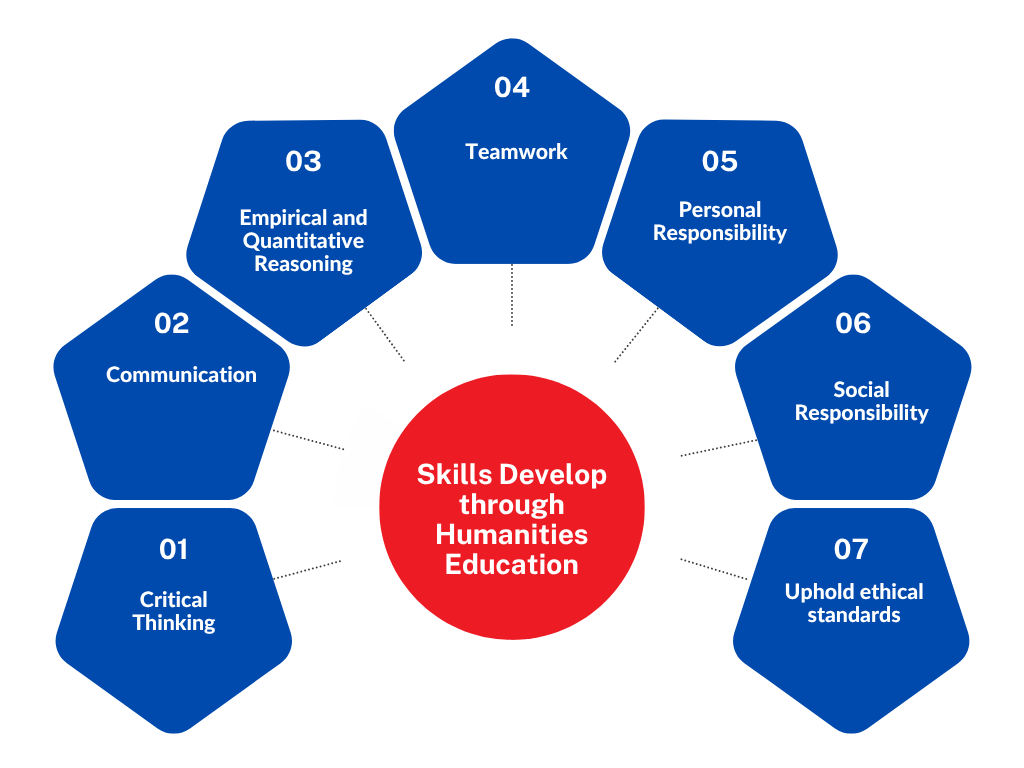
- Critical Thinking: The capacity to receive, evaluate, and creatively address information to solve problems.
- Communication: The skill to articulate unique perspectives clearly and persuasively, both verbally and in writing.
- Empirical and Quantitative Reasoning: The ability to comprehend and utilize numerical data to make informed decisions.
- Teamwork: The aptitude to comprehend diverse viewpoints and collaborate effectively with others towards shared objectives.
- Personal Responsibility: The awareness of the consequences of one's actions and the willingness to justify and be accountable for them.
- Social Responsibility: Recognizing what benefits society and the world, and the commitment to act accordingly.
- Employers seek professionals who can devise innovative solutions, communicate effectively, collaborate with colleagues, and uphold ethical standards.
Career Roles after Humanities Education
- Educator
- Author
- Public Relations Specialist
- Sales Representative
- Travel Coordinator
- Counselor
- Event Planner
- Visual Artist
- Legal Professional


