



Tech companies can gain a significant advantage by embracing emerging technologies in their early stages, as these trends have the potential to revolutionize and simplify daily life. In 2023, we expect even more exciting and transformative advancements in technologies like natural language processing and machine learning algorithms, particularly in artificial intelligence. To stay relevant and competitive, IT professionals and tech enthusiasts must be willing to learn new skills. While predicting the future of technology is challenging, this article will highlight some of the most critical tech trends that could drive overall business growth in the coming year.
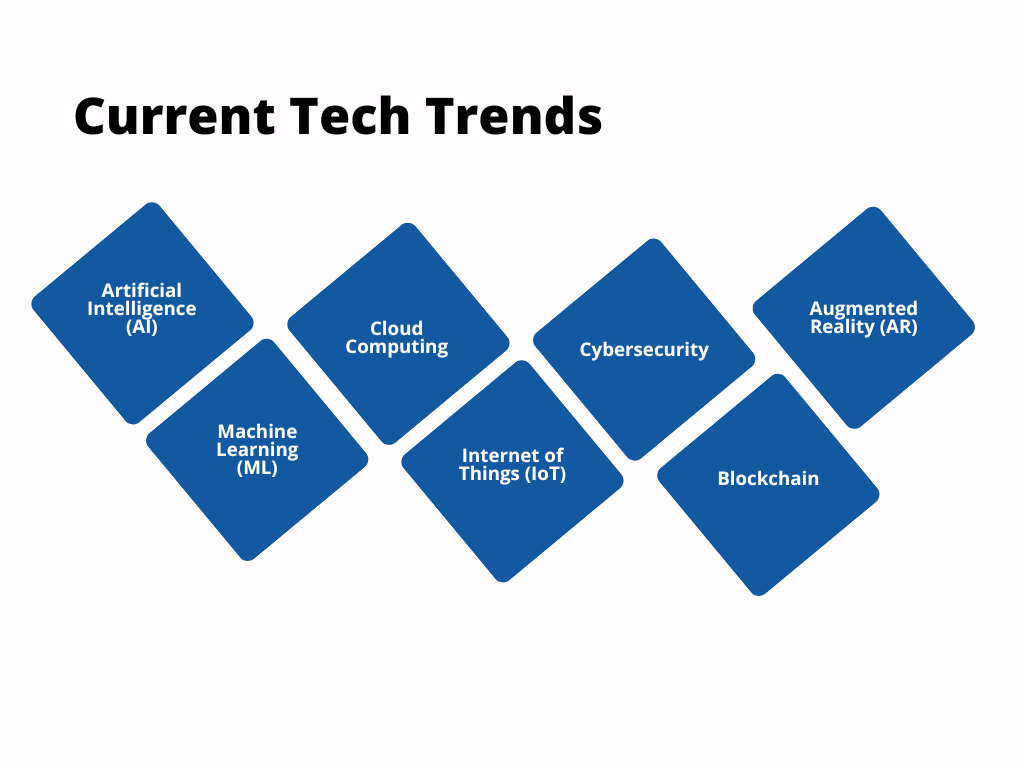
The world of technology is evolving at an unprecedented rate, and keeping up with the latest trends has become necessary for IT enthusiasts. From artificial intelligence and machine learning to cloud computing and the Internet of Things (IoT), a plethora of technologies are shaping the future of IT.
This article will discuss the top 10 current tech trends that every IT enthusiast should know about.
Top 10 current tech trends
Artificial Intelligence (AI)
Artificial Intelligence is undoubtedly one of the hottest tech trends of the decade. With advancements in machine learning and natural language processing, AI has become more intelligent and accurate in processing vast data. From self-driving cars and virtual assistants to personalized healthcare and fraud detection, AI has various applications in various industries.
One of the most exciting applications of AI is in healthcare. AI algorithms can analyze large amounts of medical data to identify patterns and predict patient outcomes. This technology can be used to develop personalized treatment plans for patients, identify high-risk patients, and even help diagnose diseases at an early stage.
Another area where AI is making a significant impact is in the field of finance. AI-powered fraud detection systems can analyze large amounts of financial data to identify fraudulent transactions and prevent losses. AI algorithms can also analyze financial markets to identify trends and predict future market conditions, which can be invaluable for investors.
Machine Learning (ML)
Machine Learning (ML) is a subset of Artificial Intelligence (AI) that uses algorithms and statistical models to enable machines to learn from data and make predictions or decisions. It allows machines to learn and improve from experience without being explicitly programmed.
The main advantage of ML is that it can process vast amounts of data quickly and identify patterns that humans may not be able to see. This makes it an essential tool for businesses that need to analyze large datasets and gain insights to improve their decision-making capabilities.
Cloud Computing
Cloud Computing has revolutionized the way businesses store and process data. Cloud computing enables organizations to scale their IT infrastructure without incurring high costs by providing on-demand access to computing resources and services. From public, private, and hybrid clouds to Infrastructure as a Service (IaaS), Platform as a Service (PaaS), and Software as a Service (SaaS), cloud computing has become an indispensable technology for modern businesses.
Cloud providers can quickly allocate and deallocate resources per the business requirement, enabling organizations to scale their IT infrastructure up or down without incurring high costs. This makes it easier for businesses to meet sudden spikes in demand or seasonal fluctuations without investing in additional hardware or software. Cloud computing offers several deployment models, including public, private, and hybrid clouds.
Internet of Things (IoT)
The Internet of Things (IoT) is a network of interconnected devices that can communicate with each other and exchange data. IoT has many applications, from smart homes and wearables to industrial automation and smart cities. IoT can potentially improve efficiency, productivity, and customer experience by connecting devices to the internet and enabling real-time data processing.
IoT devices can collect data on various parameters such as temperature, humidity, pressure, and location. This data can be analyzed to derive insights, improve efficiency, and optimize processes. For example, sensors in industrial equipment can detect when maintenance is required, preventing downtime and reducing maintenance costs.
Another significant benefit of IoT is its potential to improve customer experience. IoT devices can gather customer behaviour, preferences, and needs data, enabling businesses to personalize their offerings and provide better customer service. For example, wearable devices can collect data on a user's health and fitness, enabling them to track their progress and receive personalized recommendations.
Cybersecurity
With the increasing number of cyber threats and data breaches, cybersecurity has become a critical concern for businesses and individuals. Cybersecurity threats are becoming more sophisticated and damaging, from phishing and malware attacks to ransomware and identity theft. As a result, businesses and governments are investing heavily in cybersecurity solutions, such as firewalls, antivirus software, intrusion detection systems, and encryption.
Businesses and governments invest heavily in cybersecurity solutions to combat cybersecurity threats. Firewalls, antivirus software, intrusion detection systems, and encryption are the most common tools to protect computer systems and networks from cyber-attacks.
|
 Talk to an Expert
Blockchain
Blockchain is a distributed ledger technology that enables secure and transparent transactions between parties without intermediaries. From cryptocurrencies and smart contracts to supply chain management and digital identity verification, blockchain has various applications in various industries. By providing secure and immutable records of transactions, blockchain has the potential to improve transparency, trust, and efficiency.
Blockchain enables the secure and transparent transfer of digital assets between parties without intermediaries like banks or payment processors. Smart contracts are another application of blockchain technology which allows for the automated execution of contracts based on pre-set conditions.
Beyond cryptocurrencies and smart contracts, blockchain has various applications in various industries, including supply chain management, digital identity verification, and healthcare. In supply chain management, blockchain can track the movement of goods from the point of origin to the end customer, enabling greater transparency and accountability.
Augmented Reality (AR)
Augmented Reality (AR) is a technology that overlays digital information onto the physical world. AR has many applications, from gaming and entertainment to education and healthcare. By enhancing the user's perception of reality, AR has the potential to create immersive experiences that blur the line between the digital and physical worlds.
AR can create immersive and interactive experiences by overlaying digital objects and characters onto the physical world. For example, mobile games like Pokemon Go and Harry Potter: Wizards Unite use AR to allow players to capture virtual creatures and objects in the real world.
Virtual Reality (VR)
Virtual Reality (VR) is a technology that creates a simulated environment with which the user can interact. VR has many applications, from gaming and entertainment to education and healthcare. By creating a fully immersive experience, VR has the potential to transform the way we learn, work, and play.
VR technology has a wide range of applications in various industries. In gaming and entertainment, VR can create immersive and interactive experiences transport users to different worlds and environments. For example, VR games like Beat Saber and Half-Life: Alyx allows users to move and interact with the game's environment in a previously impossible way.
5G Networks
5G Networks are the latest generation of mobile networks that offer faster download and upload speeds, lower latency, and higher bandwidth. 5G can potentially revolutionise how we communicate, work, and access information. From autonomous vehicles and smart cities to virtual reality and remote surgery, 5G has a wide range of applications that require high-speed and reliable connectivity.
With 5G, sensors and other devices can communicate with each other in real time, allowing for more efficient and effective management of city infrastructure. With faster download speeds and lower latency, users can enjoy high-quality streaming and real-time interactions in a virtual environment.
Quantum Computing
Quantum Computing is a rapidly developing field that uses quantum-mechanical phenomena to perform complex calculations. Quantum computers can potentially solve problems that are impossible to solve with classical computers, such as breaking encryption codes and simulating complex chemical reactions. While still in its infancy, quantum computing has the potential to revolutionize the way we solve problems and process information.
Quantum computing is an exciting field with the potential to transform various industries and solve problems that are currently impossible to solve with classical computers. As research in this field continues, we expect to see more applications and innovations that could significantly impact our daily lives.
|


