



Biotechnology has emerged as one of the most promising and rapidly growing fields in science and technology in the 21st century. It is the application of scientific and engineering principles to develop novel products and processes for healthcare, agriculture, and industry. Biotechnology has the potential to revolutionise the way we live, work, and play, and Canada is at the forefront of this revolution.
Biotechnology is a broad field of study that combines biochemical, chemical, and microbiological principles to serve social development. In Canada, the demand for skilled professionals in biotechnology and life sciences is high, with 33% of employers facing a talent shortage and 20% having job vacancies in their companies.
Career opportunities for students pursuing biotechnology beyond a bachelor's degree are vast and growing as the industry seeks more skilled resources. Biotechnology is a branch of biology that intersects with various disciplines such as health sciences, agriculture, food sciences, medicine, biological pedagogy, ecology, and the environment. If you're considering studying biotechnology in Canada, this blog provides useful insights to help you build a successful career.
Canada has some of the world's best biotechnology courses and universities. This article will provide an overview of the top biotechnology courses in Canada, their fees, requirements, and the scholarships available.
Why study biotechnology in Canada?
- Canada is home to top-ranked universities offering biotechnology programs, such as the University of Toronto, the University of British Columbia, and McGill University.
- Canada has some of the most advanced research facilities in the world, such as the National Research Council of Canada, Canadian Institutes of Health Research, and the Canadian Science Centre for Human and Animal Health.
- The biotech industry in Canada is well-established, and many universities have strong partnerships with leading biotech companies, providing students with opportunities for internships, co-op placements, and job prospects.
- Biotechnology research in Canada is diverse and spans various disciplines, including medical, agricultural, environmental, and industrial biotechnology.
- Canada is a multicultural society with a welcoming environment for international students, providing a rich cultural experience that can broaden one's perspective and worldview.
- Compared to other countries such as the United States and the United Kingdom, Canadian universities offer relatively affordable tuition fees for international students, making it an attractive option for those seeking quality education at a lower cost.
- Canada offers international students the opportunity to obtain a post-graduation work permit, which can lead to permanent residency and citizenship, making it a popular destination for students seeking a long-term future in the country.
Popular Biotechnology course in Canada
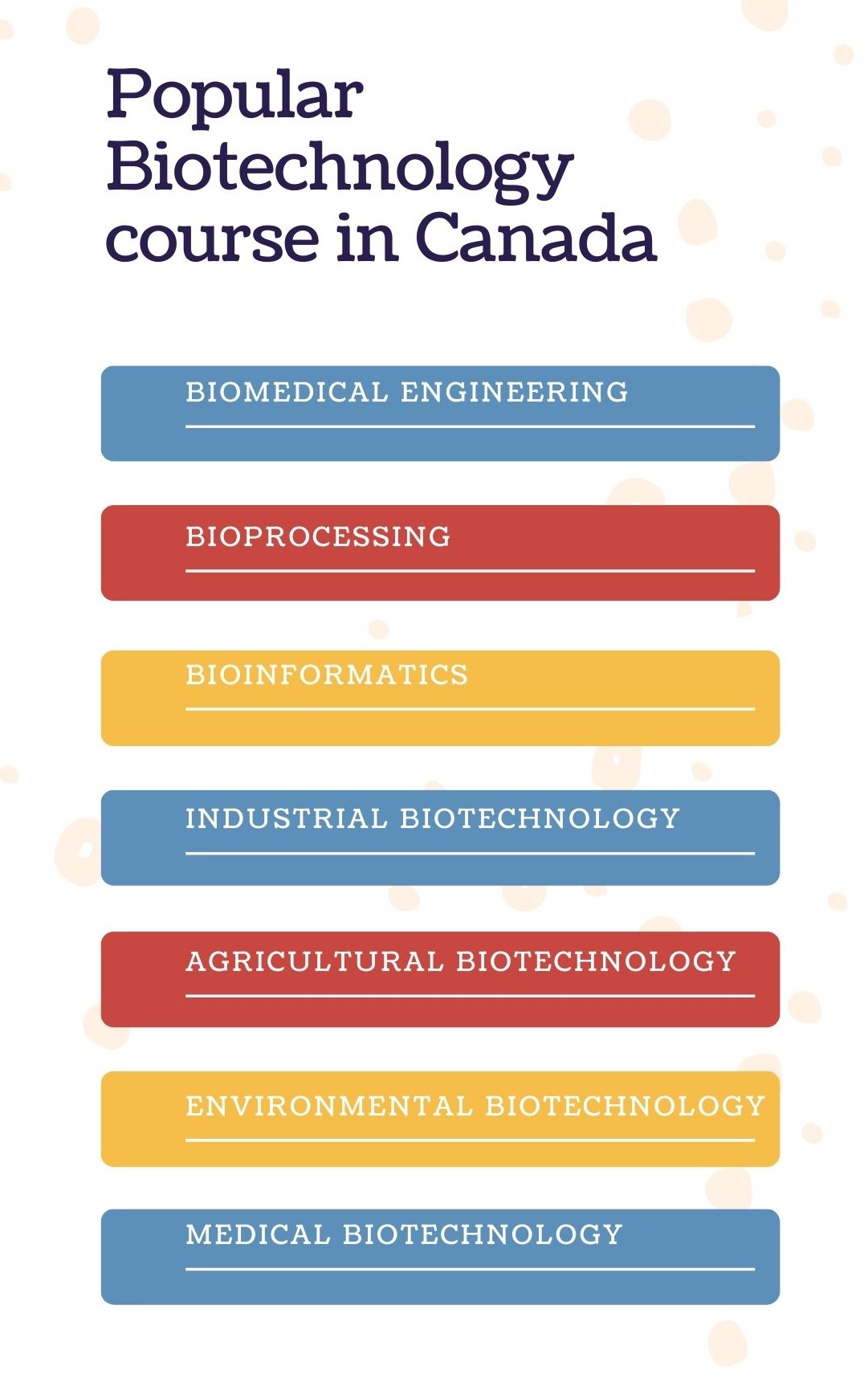
Biomedical Engineering
Biomedical engineering combines engineering principles with medical sciences to develop innovative healthcare technologies. Biomedical engineers work on developing medical devices, imaging equipment, prosthetics, and other healthcare-related technologies.
Bioprocessing
Bioprocessing involves using living cells or biological molecules for manufacturing pharmaceuticals, food, and other biologically-derived products. Bioprocessing experts work to optimise the production of these products and improve their quality and efficiency.
Bioinformatics
Bioinformatics is the application of computer science and statistics to molecular biology. Bioinformaticians develop algorithms and computational models to analyse large amounts of biological data, such as DNA sequencing data, to extract meaningful information.
Industrial Biotechnology
Industrial biotechnology involves using biological processes to produce and manufacture various products, such as biofuels, chemicals, and plastics. Industrial biotechnologists work to optimise these processes and develop new biotechnologies to improve efficiency and sustainability.
Agricultural Biotechnology
Agricultural biotechnology involves improving crop yields, increasing disease resistance, and improving overall plant quality. Agricultural biotechnologists work to develop genetically modified crops and other technologies that can improve the sustainability and productivity of agricultural systems.
Environmental Biotechnology
Environmental biotechnology involves using biotechnology to address environmental issues such as pollution, waste management, and climate change. Environmental biotechnologists work to develop new technologies that can help reduce environmental impact and improve the sustainability of human activities.
Medical Biotechnology
Medical biotechnology involves developing new treatments and therapies for human diseases. Medical biotechnologists work to develop new drugs, vaccines, and other medical technologies that can improve human health and well-being.
Top Biotechnology Colleges in Canada
|
University |
Course |
|
University of Toronto |
|
|
University of British Columbia |
|
|
University of Waterloo |
|
|
Queens University |
|
|
University of Alberta |
|
Tuition Costs
|
University |
Average Tuition Fees (CAD) |
|
University of Toronto |
$55,000 - $58,000 |
|
University of British Columbia |
$9,000 - $21,000 |
|
University of Waterloo |
$14,000 - $63,000 |
|
Queens University |
$12,000 - $48,000 |
|
University of Alberta |
$8,000 - $30,000 |
Requirements for Biotechnology Courses in Canada
Bachelor’s Degree
- Completing Grade 12 successfully with a cumulative grade point average of 60%.
- Students must have a physics, biology, math, and chemistry foundation.
- Evidence of English language competency (IELTS- 6 or above; TOEFL iBT- 85).
Master’s Degree
- A 4-year undergraduate degree with a first-class division in biotechnology or a related area (GPA 3.0 or above on a scale of 4.0)
- English language proficiency certification (IELTS 6.5/TOEFL 86)
Scholarships
Canada offers scholarships and financial aid opportunities for international students pursuing biotechnology courses. Some popular scholarships are:
- Vanier Canada Graduate Scholarships - This scholarship is awarded to top international PhD students pursuing research in health sciences, engineering, natural sciences, social sciences and humanities. The scholarship covers tuition fees, a living allowance, and other expenses.
- Trudeau Foundation Scholarships - This scholarship is awarded to international PhD students pursuing public policy, law, and human rights research. The scholarship covers tuition fees, a living allowance, and other expenses.
- Global Affairs Canada Scholarships are awarded to international students pursuing undergraduate or graduate studies in Canada. The scholarship covers tuition fees, travel expenses, and a living allowance.
- Ontario Graduate Scholarship (OGS) is awarded to graduate students pursuing science and technology, engineering, and health sciences research. The scholarship covers tuition fees, a living allowance, and other expenses.

![Best colleges in Canada for international students [10 best]](/_next/image?url=https%3A%2F%2Fs3.ap-south-1.amazonaws.com%2Fstudyinfocentre.com%2Fmedia%2Fpublic%2FContent%2Fbest-colleges-in-canada-for-international-students-10-best%2Fcompressed_Best_colleges_in_Canada_1.jpg&w=640&q=75)
![Top ranking Canada universities for 2023 [Top 8]](/_next/image?url=https%3A%2F%2Fs3.ap-south-1.amazonaws.com%2Fstudyinfocentre.com%2Fmedia%2Fpublic%2FContent%2Ftop-ranking-canada-universities-for-2021-top-8%2Fcompressed_top_ranking_universities_in_Canada_1.jpg&w=640&q=75)